
SHENZHEN, GUANGDONG, CHINA, November 28, 2026 /EINPresswire.com/ — Turning Foot Traffic Into Ad Revenue with a Wholesale Advertisement Kiosk From China
Commercial property developers, transit operators, municipal authorities, and retail facility managers continuously seek effective methods to monetize physical space. While traditional static posters and illuminated billboards provide passive visual exposure, modern digital out-of-home (DOOH) advertising channels demand dynamic, high-definition visual solutions that capture consumer attention instantly. Industry benchmarks from Grand View Research project the global DOOH advertising market to reach approximately $26.5 billion in 2026, driven by an expanding compound annual growth rate (CAGR) of 10.7% through 2030. To capitalize on this high-growth revenue stream without incurring unsustainable capital expenditure, venue operators worldwide increasingly partner with a reliable Wholesale Advertisement Kiosk From China to source specialized commercial display hardware. Sourcing directly from specialized original equipment manufacturers enables commercial network operators to deploy scalable, high-brightness displays that turn heavy foot traffic into sustainable, recurring ad revenue streams across both indoor and outdoor environments.
Architectural Segmentation: Matching Display Hardware to Environmental Demand
Deploying commercial advertising networks requires matching specific hardware profiles to the surrounding physical environment. A high-traffic indoor shopping mall demands distinct visual interaction mechanics compared to an exposed outdoor transit plaza or a temporary outdoor event space. Commercial display hardware must adapt directly to ambient lighting, space restrictions, structural loads, and user interaction requirements.
Commercial display solutions generally fall into three functional environmental tiers:
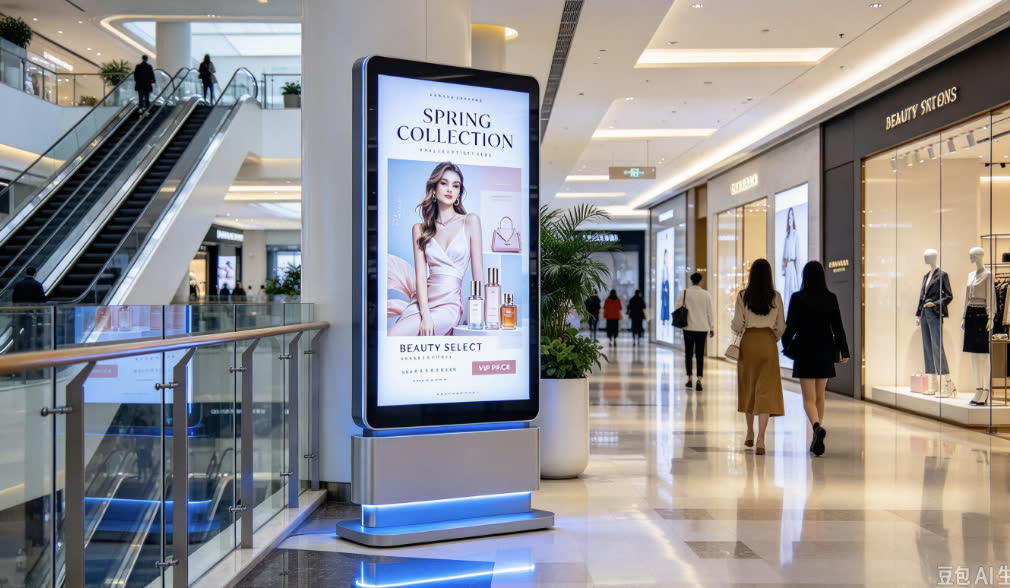
Indoor Retail Deployments: Operators prioritize dual-screen setups featuring touch interaction on the front and dynamic marketing content on the rear, maintaining a compact vertical footprint for tight walkways.
Outdoor Transit and Street Environments: Equipment requires high-brightness panels delivering 2,000 or more nits, housed inside IP65 weatherproof enclosures with automated climate management systems.
Temporary Event Operations: Mobile setups utilize battery-powered LED configurations mounted on heavy-duty wheels to support rapid deployment without reliance on fixed electrical infrastructure.
In controlled indoor retail environments, commercial operators favor dual-screen architecture. Terminals featuring interactive touch panels on the front coupled with secondary promotional panels on the rear maximize spatial efficiency in narrow mall corridors and store entrances. Conversely, semi-outdoor and fully exposed outdoor locations demand heavy-duty structural engineering. Outdoor displays require high-brightness LED and LCD panels ranging from 1,500 to over 2,500 nits to maintain crystal-clear visibility under direct sunlight. Furthermore, temporary marketing pop-ups, food festivals, and outdoor concerts require mobile, battery-powered display units that eliminate reliance on external power outlets while delivering high-impact visual performance.
Engineering for Outdoor Environments: Thermal Management, Enclosure Ratings, and Sunlight Readability
Hardware operating in unconditioned outdoor environments faces harsh environmental factors, including extreme temperature swings, rain, snow, ambient dust, and direct solar radiation. Ensuring continuous 24/7 display operation requires robust thermal management systems and ruggedized physical enclosures. Standard indoor screens fail quickly under direct solar exposure due to internal heat buildup and backlight fading, leading to permanent liquid crystal damage, black spots, and operational downtime.
Engineers address these physical challenges by combining high-brightness industrial panels with advanced optical bonding and anti-glare tempered glass. Optical bonding reduces internal light reflection, increasing contrast ratios and sunlight readability even in intense high-ambient-light conditions. Furthermore, outdoor hardware utilizes IP65-rated weatherproof enclosures that prevent water ingress and airborne dust contamination. Integrated intelligent climate control systems, featuring automated cooling fans and heating elements, regulate internal enclosure temperatures across extreme seasonal cycles. These structural safeguards protect internal electronics, preserve component longevity, and maintain stable visual output across harsh operating conditions.
Strategic Placement and Revenue Optimization Across Diverse Footprint Scenarios
Maximizing advertising yield depends directly on strategic hardware placement, traffic density, and alignment with consumer dwell times. Commercial operators deploy specific screen configurations across three primary venue categories to optimize impression counts, viewer retention, and user engagement.
Shopping Malls and Retail Arcades Indoor retail hubs leverage dual-screen terminals, such as the HD4 dual screen advertising terminal, placed along high-density walkways, escalator hubs, and food court entrances. The primary screen offers interactive store directory navigation and wayfinding services, while the rear display streams continuous video advertising to passing shoppers, monetizing idle viewing time effectively.
Transit Hubs and Municipal Plazas Bus terminals, train stations, ferry piers, and public plazas deploy rugged outdoor multi-touch digital signage networks, including the W1, W3, W5, and WD5 outdoor kiosk series. Placed directly near passenger waiting areas and ticketing gates, these high-brightness displays broadcast dynamic arrival schedules alongside localized programmatic advertisement loops.
Outdoor Venues and Event Pop-Ups Event organizers, stadium operators, and street venues utilize portable, battery-powered outdoor displays, such as the YW10 mobile LED signage system. Equipped with built-in rechargeable battery packs and rugged castor wheels, these flexible units allow operators to position promotional displays rapidly at concert gates, outdoor markets, and sporting events without complex cable infrastructure.
Sourcing Direct from China: Cost Efficiency, Customization, and Manufacturing Standards
Building a scalable, multi-location digital out-of-home network requires significant capital investment in hardware assets. Procurement teams achieve superior return on investment (ROI) by establishing direct manufacturing partnerships with established factory exporters in China. Sourcing directly eliminates intermediate distributor markups and regional agency surcharges, allowing network operators to deploy larger display fleets within fixed budget parameters.
Direct factory collaboration provides comprehensive customization flexibility across both hardware and software tiers. Commercial buyers work alongside engineering teams to tailor housing dimensions, custom color schemes, peripheral integrations, and screen configurations to precise site requirements. Established manufacturing partners, such as ZKTEK (SHENZHEN ZHONGKONG COMPUTERS CO., LTD.), execute rigorous quality control protocols across all assembly stages. Production lines conduct thermal stress testing, vibration analysis, panel burn-in procedures, and ingress protection validation prior to global shipment. Furthermore, full compliance with international standards, including CE, FCC, and RoHS certifications, ensures smooth regulatory approval and reliable long-term performance across global deployment destinations.
Conclusion: Scaling Commercial Display Networks with ZKTEK Hardware
The rapid expansion of global digital out-of-home advertising highlights the commercial necessity of modernizing physical media networks. Commercial property managers, transit agencies, and media operators transform static foot traffic into consistent ad revenue by deploying high-performance indoor and outdoor advertising kiosks. Sourcing customized, high-brightness commercial display hardware directly from experienced Chinese manufacturing partners guarantees structural durability, international safety compliance, and long-term cost efficiency. By combining advanced display engineering with flexible OEM/ODM manufacturing capabilities, commercial network operators build resilient digital signage infrastructure that drives continuous advertising yield.
To review full hardware specifications and explore customized commercial display solutions, visit https://www.zktek.com/.
ZKTEK
ZKTEK
email us here
Legal Disclaimer:
EIN Presswire provides this news content “as is” without warranty of any kind. We do not accept any responsibility or liability
for the accuracy, content, images, videos, licenses, completeness, legality, or reliability of the information contained in this
article. If you have any complaints or copyright issues related to this article, kindly contact the author above.

Media gallery