NANTONG, JIANGSU, CHINA, July 29, 2026 /EINPresswire.com/ — A procurement-oriented guide to defining the production-flow, data and storage boundaries before an intelligent hanger-system project.
A CleverMax Hanger System factory upgrade should begin with a production and data-design brief, not with a generic equipment comparison. The Hanger System can provide RFID-enabled material flow; the CleverMax MES system can organize production data; and WMS can manage warehouse tasks and inventory locations. Together, they can support a connected workflow from cutting through storage. The practical first step is to collect the eight factory inputs that determine layout, routing, capacity and integration scope.
Start with the operating problem, not the equipment label
Factories usually feel the need to upgrade when manual movement, bundle searching, work-in-progress accumulation, uneven stations or delayed reports make it difficult to respond to changing orders. Replacing a rail line alone does not resolve those problems unless the physical route, RFID events, workstation rules and software ownership are designed together.
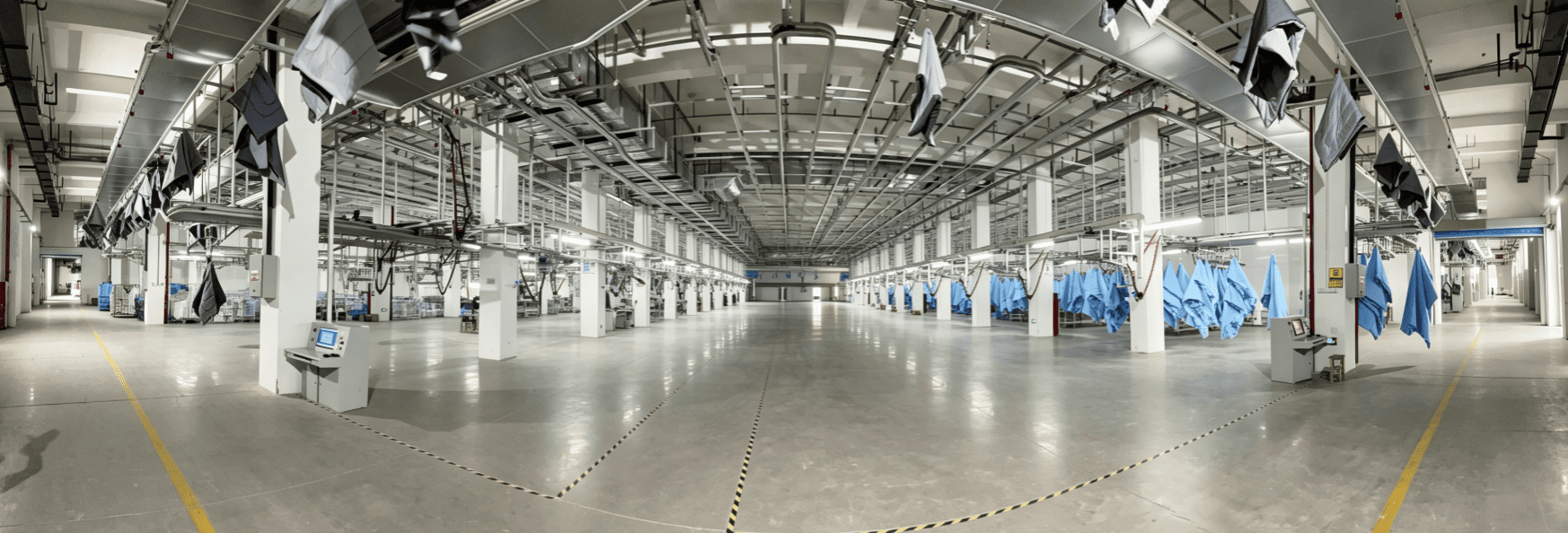
CleverMax states that its intelligent hanger system moves cut pieces, components, semi-finished goods and work-in-progress through an overhead rail network while RFID, smart workstations and production software record what is moving and where it is in the process. The value proposition is a controlled production flow with a usable data trail, not a claim that every factory will produce the same result after installation.
An overhead garment hanger installation in a production environment. Image retained from the supplied source article.
Define the connected architecture before requesting a quotation
The Hanger System, CleverMax MES system and WMS have different jobs. The Hanger System is the production-flow backbone: it carries items and can provide RFID-based process events. CleverMax MES system is the operations layer: CleverMax describes it as handling production information such as orders, processes, people, work-in-progress and output. WMS is the storage layer: it manages warehouse tasks and inventory locations. ERP remains the enterprise system that may provide orders, master data or financial context.
This separation is important during procurement. A project team should state which system creates each identifier, which system is authoritative for each status, how exceptions are corrected and which interfaces are required. Without those choices, an “integrated” proposal can become a collection of disconnected screens and transports.
The eight inputs to prepare before layout and capacity design
The following checklist converts a broad upgrade conversation into data a supplier and factory team can test together. It is deliberately practical: the goal is to create an inspectable basis for a layout, a capacity model and an integration plan.
1.DWG layout: provide the current factory drawing, including columns, clear heights, fire and access constraints, doors, utilities and relevant equipment obstacles.
2.Product types and weights: identify garment, home-textile or other product families, their dimensions, handling needs and any load-sensitive items.
3.Process route: list the operations, rework loops, inspection points, sorting rules and any alternative paths by product family.
4.Workstation count: show the current and planned stations by operation, along with staffing assumptions and shift pattern.
5.Hourly capacity: define target output by product family and the expected peak, average and changeover demand rather than one undifferentiated daily total.
6.Style-change frequency and WIP: describe order-mix volatility, batch sizes, current WIP locations, congestion points and the desired buffer policy.
7.Existing ERP, MES and WMS: document the current applications, available interfaces, master-data owners, identifiers and required reporting outputs.
8.Expansion plan: state the likely future lines, workshops, buildings, storage capacity and multi-site management needs so the first phase does not block the next one.
Use RFID and dynamic balancing as mechanisms, not slogans
RFID can give each tracked item a digital identity that connects the physical carrier to its order, process stage and station event. That does not remove the need for data governance. The project still needs rules for tag association, missing reads, repairs, rework, manual overrides, quality holds and the handoff between production and storage.
CleverMax reports that dynamic balancing and AI-driven dispatching can consider order progress, workstation load, employee efficiency, WIP quantity and real-time bottlenecks when adjusting task allocation and hanger routes. The company further states that, with comparable products, processes, staffing and production conditions, this approach can improve overall efficiency by 25 to 35 percent compared with a conventional hanger system. The relevant test is whether the proposal specifies the data inputs, routing rules, visible exceptions and comparison baseline for the customer’s factory.
Read performance figures with their project conditions attached
CleverMax reports that integrated intelligent hanger and MES projects can deliver “efficiency increases of 30 percent or more” and “WIP reduced by up to 50 percent.” These are project-reporting figures, not a universal guarantee. They must be read against the original production baseline, product mix, process design, staffing, measurement period, deployment scope and the definition of WIP used in the comparison.
For a procurement decision, request an agreed measurement sheet before commissioning: baseline output and hours, WIP counting points, delivery period, style mix, downtime treatment, quality/rework treatment and who validates the result. Actual results depend on project conditions, including layout, processes, data quality, training, change management, product mix and the customer’s operational discipline. This keeps a useful target from being mistaken for a transferable average.
Plan suspended storage as part of the flow
Suspended or aerial storage can be valuable when the factory needs temporary, controlled buffering between sewing, inspection, sorting and later operations. CleverMax describes aerial buffering, intelligent sorting and warehouse links as part of its broader factory solution. But the decision should start with flow analysis: what is stored, for how long, under which quality status, with what access priority and under what building and safety conditions?
A WMS connection becomes meaningful when warehouse tasks and locations are synchronized with the physical handoff. The implementation team should define when responsibility moves from production to storage, which RFID or barcode events confirm that move, and how the system handles blocked, reworked or urgent items.
A practical project sequence
A sound next step is a joint discovery session using the eight inputs. The factory team can validate product routes and constraints; the supplier can draft a layout and data-boundary proposal; the IT team can confirm interfaces; and operations can establish measurable acceptance conditions. Phasing may begin with a priority line or workshop before extending to connected storage or multiple sites.
CleverMax states that it can provide factory planning, system design, equipment manufacture, software integration, project implementation and after-sales support for medium and large projects. That scope should be converted into a named responsibility matrix, implementation schedule, data-integration plan, training plan and acceptance checklist for the specific project.
Source Notes
1. Company architecture, product scope and project contact route: CleverMax official website. Capability and performance statements in this article are attributed to CleverMax and require project-specific confirmation.
2. Official record route for standards research: China National Standards search page. Verify the title, number, issuing body and drafting-unit information on the official record before using any standards claim in external communications.
NANTONG MINGXING SCIENCE & TECHNOLOGY DEVELOPMENT CO., LTD
NANTONG MINGXING SCIENCE & TECHNOLOGY DEVELOPMENT CO., LTD
+ +86 15851212811
email us here
Visit us on social media:
LinkedIn
Facebook
Legal Disclaimer:
EIN Presswire provides this news content “as is” without warranty of any kind. We do not accept any responsibility or liability
for the accuracy, content, images, videos, licenses, completeness, legality, or reliability of the information contained in this
article. If you have any complaints or copyright issues related to this article, kindly contact the author above.

Media gallery