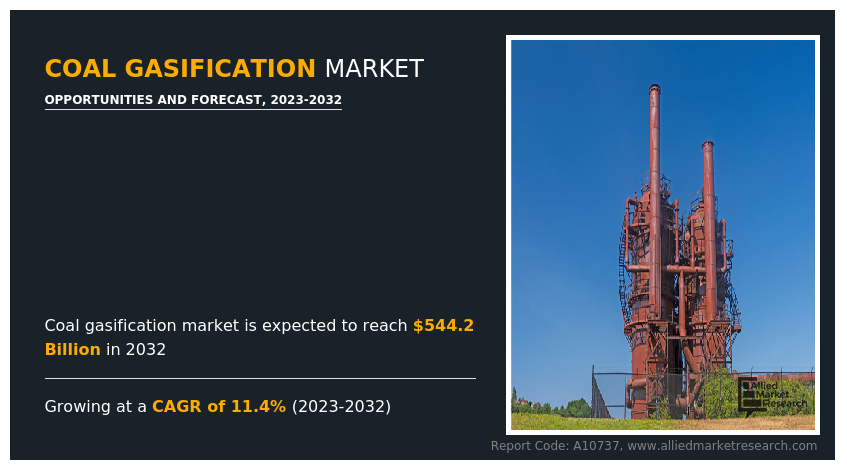
Coal gasification market is projected to reach $544.2 billion by 2032, fueled by clean energy investments and hydrogen demand.
WILMINGTON, DE, UNITED STATES, June 4, 2026 /EINPresswire.com/ —
According to a new report published by Allied Market Research, the coal gasification market size was valued at $186.9 billion in 2022 and is projected to reach $544.2 billion by 2032, registering a CAGR of 11.4% from 2023 to 2032.
The growing global focus on cleaner energy technologies, efficient resource utilization, and industrial decarbonization is creating significant opportunities for the coal gasification market. Coal gasification has emerged as an important technology that enables the conversion of coal into synthesis gas, commonly known as syngas, which can be utilized in power generation, chemical manufacturing, fertilizer production, hydrogen generation, and various industrial applications. As governments and industries seek alternatives to traditional coal combustion, the adoption of advanced gasification technologies continues to increase across major economies.
Download PDF Brochure: https://www.alliedmarketresearch.com/request-sample/A10737
Understanding Coal Gasification Technology
Coal gasification is a thermochemical process that converts coal into a combustible gaseous mixture known as syngas. The process takes place under controlled high-temperature and high-pressure conditions where coal reacts with oxygen, steam, or air. Instead of burning coal directly, gasification breaks it down into its fundamental chemical components.
The resulting syngas primarily contains hydrogen and carbon monoxide, along with smaller quantities of methane, carbon dioxide, and other gases. This gas mixture can then be used as a feedstock for electricity generation, hydrogen production, synthetic fuels, fertilizers, and numerous chemical products.
One of the major advantages of coal gasification is its flexibility. The technology can process different grades of coal, including low-quality coal and coal waste. In addition, gasification systems can utilize alternative feedstocks such as biomass, municipal solid waste, industrial waste, and waste plastics. This versatility supports waste management initiatives while contributing to energy generation and industrial productivity.
Growing Demand for Syngas Across Industries
The increasing utilization of syngas in industrial operations is one of the primary factors driving market expansion. Syngas serves as a critical raw material in various sectors, including chemicals, fertilizers, power generation, and transportation fuels.
Chemical manufacturers rely on syngas for producing methanol, ammonia, and numerous industrial chemicals. In the fertilizer industry, syngas is used for ammonia production, which forms the foundation of nitrogen-based fertilizers. As global agricultural production continues to rise, demand for fertilizers is expected to strengthen, creating additional opportunities for coal gasification technologies.
The power generation sector is also adopting gasification technologies due to their ability to deliver improved efficiency compared to traditional coal-fired power plants. Integrated Gasification Combined Cycle (IGCC) plants offer enhanced operational performance and lower emissions, making them attractive for countries seeking cleaner energy solutions while utilizing domestic coal resources.
Government Support Accelerating Market Growth
Government initiatives and policy support play a crucial role in advancing the coal gasification market. Many countries are implementing programs, incentives, and funding mechanisms to encourage the development of cleaner energy technologies and reduce dependence on conventional coal combustion.
India has emerged as one of the most active countries in promoting coal gasification. The Indian government has established ambitious plans to gasify 100 million metric tons of coal by 2030. To support this objective, policymakers are encouraging public-private partnerships and attracting investments from domestic and international stakeholders.
Similarly, the United States continues to invest in advanced gasification technologies through various energy programs. The U.S. Department of Energy’s Gasification Systems Program focuses on developing innovative and modular gasification systems capable of processing coal, biomass, municipal solid waste, and other feedstocks. These initiatives are designed to produce clean syngas for electricity generation, hydrogen production, transportation fuels, and high-value chemicals.
Such government-backed programs are helping create a favorable investment environment and encouraging technological innovation throughout the industry.
Rising Importance of Hydrogen Production
Hydrogen has become a central component of global energy transition strategies, and coal gasification is increasingly being utilized as a pathway for hydrogen generation. The growing demand for hydrogen in transportation, power generation, refining, and industrial applications is creating substantial growth opportunities for the market.
Countries worldwide are investing heavily in hydrogen infrastructure to achieve decarbonization goals. Coal gasification combined with carbon capture technologies can support large-scale hydrogen production while reducing environmental impact. As hydrogen economies continue to develop, gasification facilities are expected to play a critical role in meeting future demand.
The increasing focus on hydrogen generation is anticipated to be one of the strongest growth drivers for the coal gasification industry during the forecast period.
Role of Coal Gasification in Waste-to-Energy Projects
Another major advantage of coal gasification technology is its contribution to waste management and resource recovery. Modern gasification systems can process various waste materials, including municipal solid waste, industrial waste, agricultural residues, and biomass.
By converting waste into valuable energy products, coal gasification supports circular economy initiatives and reduces the environmental burden associated with land filling and waste disposal. Governments and municipalities are increasingly exploring waste-to-energy projects as part of their sustainability strategies.
The ability to transform waste streams into electricity, fuels, and chemical feedstocks enhances the economic viability of gasification projects and strengthens market growth prospects.
Environmental Challenges Facing the Industry
Despite its advantages, the coal gasification market faces several environmental and regulatory challenges. Although gasification generally produces fewer emissions compared to direct coal combustion, the process still generates carbon dioxide and other pollutants.
As environmental regulations become more stringent worldwide, market participants must invest in emission control technologies and carbon management solutions. Public concerns regarding climate change and greenhouse gas emissions continue to influence energy policy decisions, potentially affecting future project approvals.
Coal mining activities associated with feedstock supply can also create environmental concerns related to land degradation, groundwater contamination, and ecosystem disruption. These issues have increased scrutiny of coal-based energy technologies and may present challenges for industry expansion.
To address these concerns, companies are increasingly integrating carbon capture, utilization, and storage (CCUS) technologies into gasification projects. These solutions can significantly reduce emissions and improve the sustainability profile of coal gasification operations.
Buy This Report (300 Pages PDF with Insights, Charts, Tables, and Figures): https://www.alliedmarketresearch.com/coal-gasification-market/purchase-options
Technological Advancements Creating New Opportunities
Continuous technological innovation is transforming the coal gasification landscape. Equipment manufacturers and engineering companies are developing more efficient gasifiers, improved process controls, and advanced monitoring systems that enhance operational performance.
Modern gasification facilities are becoming increasingly flexible and capable of processing diverse feedstocks while maximizing syngas yields. Digital technologies, automation, artificial intelligence, and predictive maintenance solutions are also improving plant reliability and reducing operating costs.
Retrofitting existing coal-fired power plants with gasification technologies represents another promising growth opportunity. Such upgrades can extend plant lifespans, improve efficiency, and reduce emissions while leveraging existing infrastructure investments.
As technology continues to evolve, coal gasification is expected to become more competitive and environmentally sustainable.
Market Segmentation Analysis
The coal gasification market is segmented by gasifier type, application, and region.
Based on gasifier type, the market includes fixed bed, fluidized bed, and entrained flow gasifiers. Among these, the fluidized bed gasifier segment emerged as the leading category in 2022 and is expected to register the fastest growth during the forecast period. Fluidized bed systems offer superior fuel flexibility, efficient heat transfer, and improved operational performance, making them highly suitable for large-scale industrial applications.
By application, the market is categorized into fertilizers, electricity generation, chemicals, hydrogen generation, steel production, and others. Electricity generation accounted for the largest market share in 2022 due to increasing demand for reliable and efficient power generation technologies. However, hydrogen generation is expected to witness the fastest growth over the forecast period, driven by expanding investments in hydrogen infrastructure and clean energy initiatives.
Regional Insights
Asia-Pacific dominated the global coal gasification market in 2022 and is projected to maintain its leadership throughout the forecast period. Rapid industrialization, growing energy demand, abundant coal reserves, and supportive government policies contribute significantly to regional market growth.
China remains one of the largest adopters of coal gasification technology, utilizing syngas for chemicals, fertilizers, and energy production. India is also investing heavily in gasification projects to enhance energy security and reduce dependence on imported fuels.
North America continues to benefit from ongoing technological innovation and government support for advanced gasification systems. The region’s focus on hydrogen production and carbon capture integration is expected to create additional growth opportunities.
Europe is witnessing increasing interest in gasification technologies as part of broader energy transition strategies. Meanwhile, Latin America and other emerging regions are exploring gasification projects to improve energy access and industrial development.
Competitive Landscape
The coal gasification market features several prominent companies focused on technological advancement, strategic partnerships, and capacity expansion. Major market participants include Air Liquide, Mitsubishi Heavy Industries Ltd., Air Products, Thyssenkrupp Uhde GmbH, Andritz, Dakota Gasification Company, Sedin Engineering Co. Ltd., Sasol Limited, Linc Energy Ltd., and Shanxi Lu’an Mining Group Co., Ltd.
These companies are actively investing in research and development to enhance gasification efficiency, reduce emissions, and expand their global presence. Collaborations, acquisitions, product innovations, and facility expansions remain key strategies for maintaining competitive advantage in the evolving market landscape.
Impact of COVID-19 on the Coal Gasification Market
The COVID-19 pandemic created several challenges for the coal gasification industry. Travel restrictions, quarantine requirements, labor shortages, and disruptions in supply chains affected project execution and operational efficiency across multiple regions.
Construction schedules were delayed due to workforce limitations and logistical challenges. In addition, disruptions in raw material supply and industrial production negatively impacted demand from end-use sectors, including chemicals and manufacturing.
However, as economies gradually recovered and industrial activity resumed, demand for energy, chemicals, and hydrogen production increased. Government investments in infrastructure and clean energy projects also supported market recovery. As a result, the long-term outlook for the coal gasification market remains positive despite temporary disruptions caused by the pandemic.
Get a Customized Research Report: https://www.alliedmarketresearch.com/request-for-customization/A10737
Conclusion
The coal gasification market is poised for substantial growth over the next decade as industries seek cleaner, more efficient, and versatile energy solutions. The technology’s ability to convert coal and waste materials into valuable syngas for electricity generation, chemical production, fertilizer manufacturing, and hydrogen generation positions it as a critical component of the evolving energy landscape.
Supportive government policies, rising investments in hydrogen infrastructure, advancements in gasification technologies, and expanding industrial applications are expected to drive market expansion. Although environmental challenges and regulatory pressures remain significant considerations, ongoing innovation and carbon management initiatives are helping strengthen the long-term viability of coal gasification technologies.
With the market projected to reach $544.2 billion by 2032, coal gasification is set to play an increasingly important role in supporting energy security, industrial growth, and the transition toward more sustainable energy systems worldwide.
Trending Reports in Energy and Power Industry:
Coal Gasification Market
https://www.alliedmarketresearch.com/coal-gasification-market-A10737
Gasification Market
https://www.alliedmarketresearch.com/gasification-market
Biomass Gasification Market
https://www.alliedmarketresearch.com/biomass-gasification-market-A09297
Energy Transition Market
https://www.alliedmarketresearch.com/energy-transition-market-A31819
Decarbonization Market
https://www.alliedmarketresearch.com/decarbonization-market-A325581
Power-To-X Market
https://www.alliedmarketresearch.com/power-to-x-market-A325620
About Us
Allied Market Research (AMR) is a full-service market research and business-consulting wing of Allied Analytics LLP based in Portland, Oregon. Allied Market Research provides global enterprises as well as medium and small businesses with unmatched quality of “Market Research Reports” and “Business Intelligence Solutions.” AMR has a targeted view to provide business insights and consulting to assist its clients to make strategic business decisions and achieve sustainable growth in their respective market domain.
Pawan Kumar, the CEO of Allied Market Research, is leading the organization toward providing high-quality data and insights. We are in professional corporate relations with various companies and this helps us in digging out market data that helps us generate accurate research data tables and confirms utmost accuracy in our market forecasting. Each and every data presented in the reports published by us is extracted through primary interviews with top officials from leading companies of domain concerned. Our secondary data procurement methodology includes deep online and offline research and discussion with knowledgeable professionals and analysts in the industry.
David Correa
Allied Market Research
+ + + + + + + + + + + + +1 800-792-5285
email us here
Visit us on social media:
LinkedIn
Facebook
YouTube
X
Legal Disclaimer:
EIN Presswire provides this news content “as is” without warranty of any kind. We do not accept any responsibility or liability
for the accuracy, content, images, videos, licenses, completeness, legality, or reliability of the information contained in this
article. If you have any complaints or copyright issues related to this article, kindly contact the author above.

Media gallery