
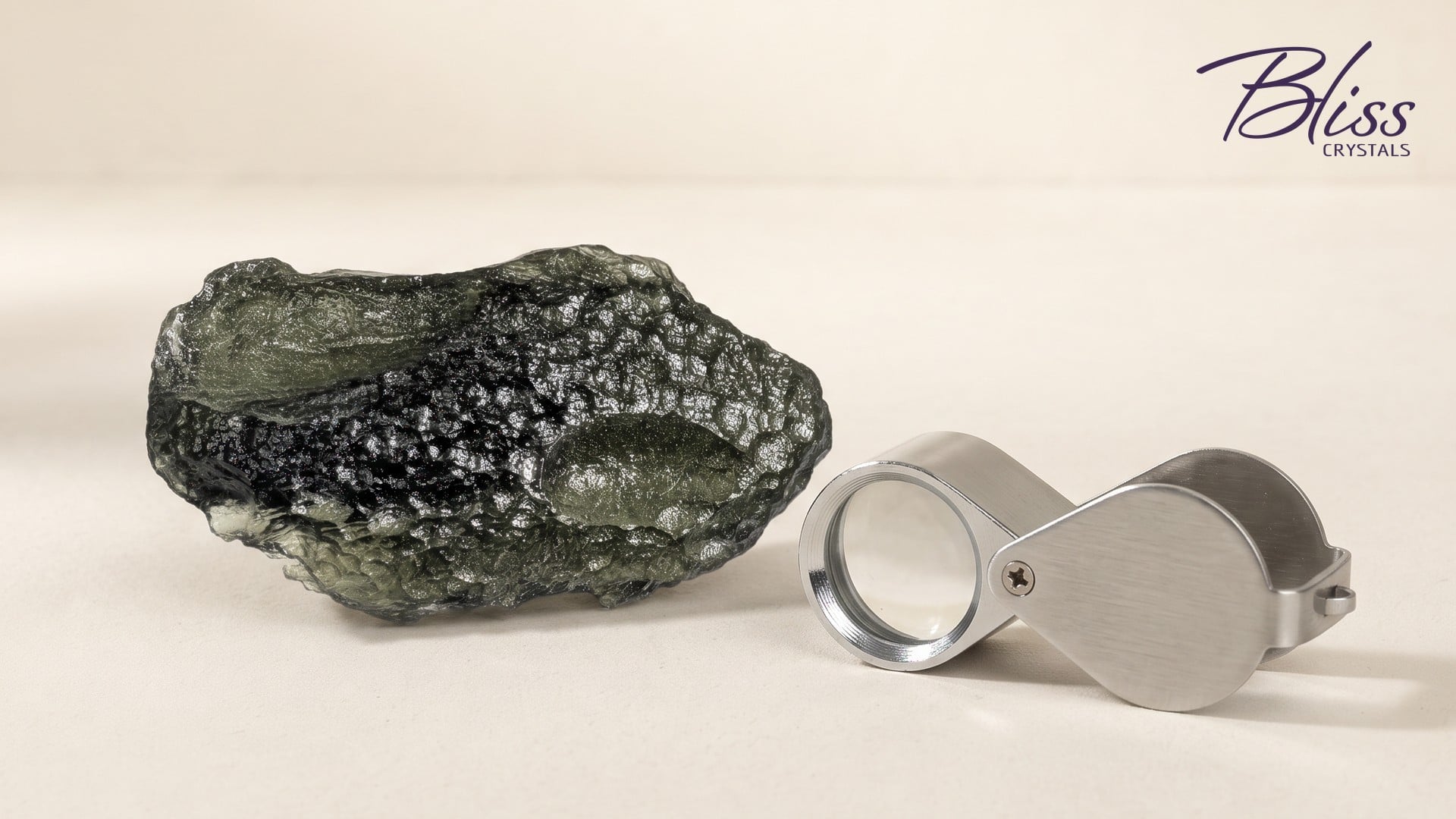
Moldavite is one of the most counterfeited stones on the market, and much of the inexpensive “moldavite” sold online is simply green glass. Bliss Crystals, a crystal and jewelry retailer in Temecula, California, has published a buyer’s guide that sets out how to tell the difference. The guide, released [DATE], draws on the company’s 20 years of buying moldavite from a single Czech dealer licensed by the Czech government.
What moldavite is
Moldavite is a tektite, a natural glass formed about 15 million years ago when a large meteorite struck the Earth. Genuine moldavite comes from the Czech Republic. The strewn field reaches slightly into Austria and Germany, but finds outside Czech borders are extremely rare. Because supply is limited and the stone is sold by the gram, it is an easy target for counterfeiters.
The eight checks
Check 1: Texture. Real moldavite has a matte surface of irregular pits, wrinkles and folds, sometimes slightly frosted. It is not shiny unless it has been polished or faceted. Fakes are usually cast from green glass or resin and often look wet and glassy. Some counterfeiters now add fake texture or etch the surface, so the guide treats texture as a warning sign rather than proof.
Check 2: Internal structure. Under a jeweler’s loupe, genuine moldavite shows some combination of flow lines, elongated gas bubbles and tiny dark rods of lechatelierite, a mineraloid formed in a violent burst of heat. Perfectly round bubbles, or a clear interior with no flow lines, are reasons for suspicion.
Check 3: Color. Real moldavite is a soft, variable moss, olive or forest green. Green is its only color. Listings for “newly discovered” purple, white, gold, blue, pink or black moldavite describe other stones or fakes.
Check 4: Size. Authentic moldavite is overwhelmingly small and is weighed in grams, not ounces. Unusually large pieces, or carvings bigger than a fingernail, call for close scrutiny.
Check 5: Shape. No two natural pieces are alike. A lot of identical-looking pieces suggests they came from the same mold.
Check 6: Origin. Moldavite is defined as the green tektite found in the Czech Republic. “African” or “Colombian” moldavite describes other tektites, and “lab-created” moldavite is colored glass.
Check 7: Price. Genuine moldavite is expensive and sold by the gram. A very low price is usually a sign of a fake. An extremely high, non-competitive price can also be a warning.
Check 8: Beads. Round moldavite beads are almost always imitations. Forming the stone into beads takes too much costly material, and a rounded bead loses the natural sculpted texture. The guide notes that authentic beads are extremely rare and made only occasionally by skilled Czech artisans.
Certificates and sellers
The guide cautions that a printed certificate of authenticity proves little on its own, because certificates are easy to create. A high review count on a large online marketplace is no guarantee either, since those platforms cannot authenticate every product they carry. Its central advice is to buy in person from an established dealer, or from one whose reputation can be verified, and to choose a seller willing to show genuine and imitation pieces side by side.
About Bliss Crystals
Bliss Crystals sells natural crystals, tumbled stones and jewelry online and at its showroom in Temecula, California. The company states on each listing when a stone has been treated, dyed or enhanced.
Research summaries on moldavite and the Ries impact that formed it are available from Science.gov: https://www.science.gov/topicpages/m/moldavites.html.
The full guide is available at https://blisscrystals.com/blogs/learn/moldavite-real-or-fake-how-to-spot-authentic-moldavite.
Bliss Crystals ®
40466 Winchester Rd
Temecula
CA
92591
United States


